
BMI Calculator
Health Resources & Calculators
- Adults ADHD Symptoms Test
- Amoxicillin Dose Calculator
- Bi-Est Compounding Calculator
- Tri-Est Compounding Calculator
- BMI Calculator
- Clarks Rule Calculator
- Elemental Iron Calculator
- Ear Drops Day Supply
- Eye Drops Day Supply
- Ibuprofen Dose Calculator
- Insulin Calculator
- Tablet Daily Supply
- Tri-Est Compounding Calculator
- Infant Tylenol Dosage Calculator
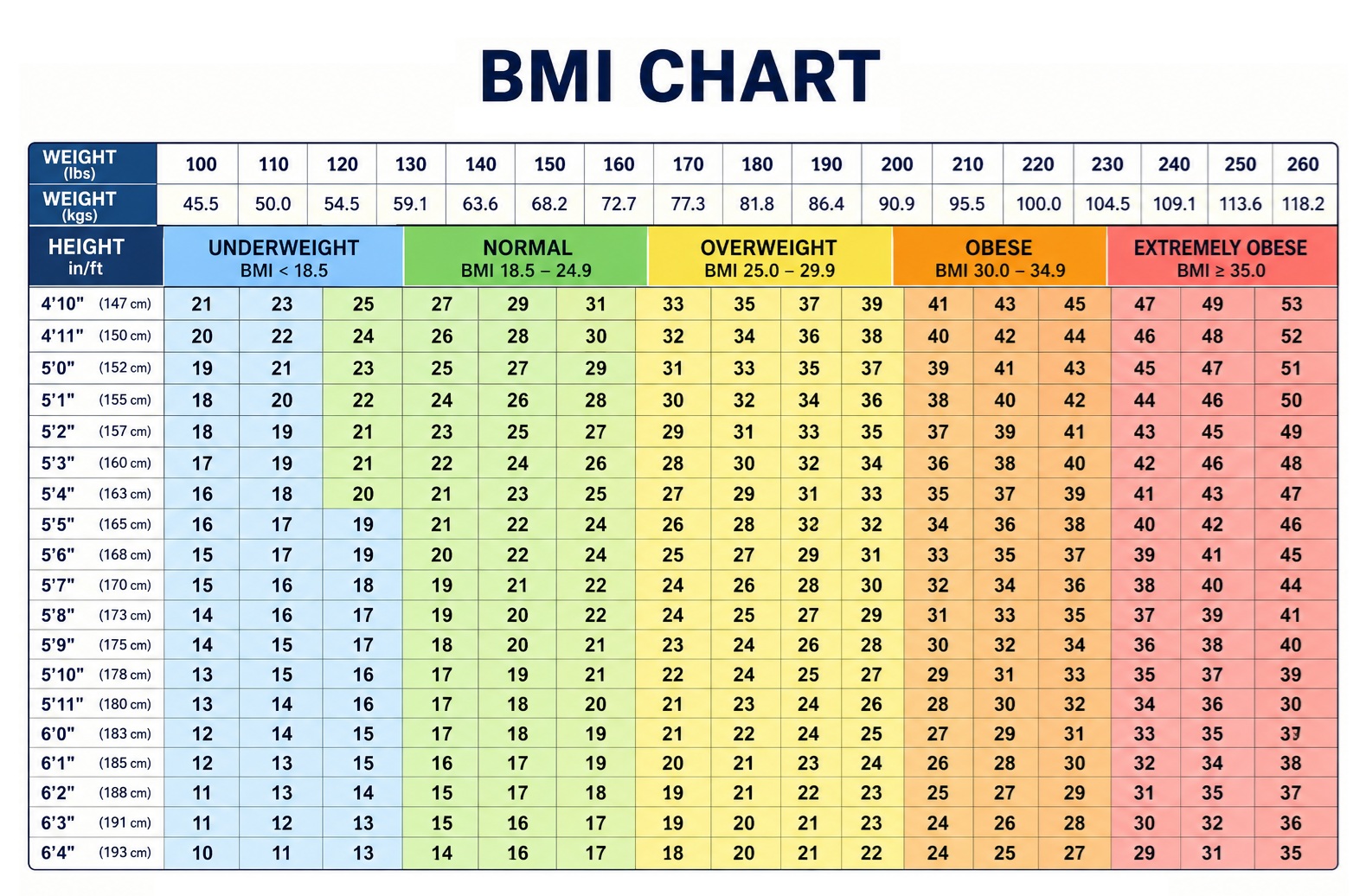
BMI Classification Chart
| BMI (kg/m²) | Classification | Health Risk |
| Below 18.5 | Underweight | Nutritional deficiency |
| 18.5 – 24.9 | Healthy Weight | Lowest Risk |
| 25 – 29.9 | Overweight | Increased Risk |
| 30 – 34.9 | Obesity Class I | High Risk |
| 35 – 39.9 | Obesity Class II | Very High Risk |
| 40+ | Obesity Class III | Extremely High Risk |
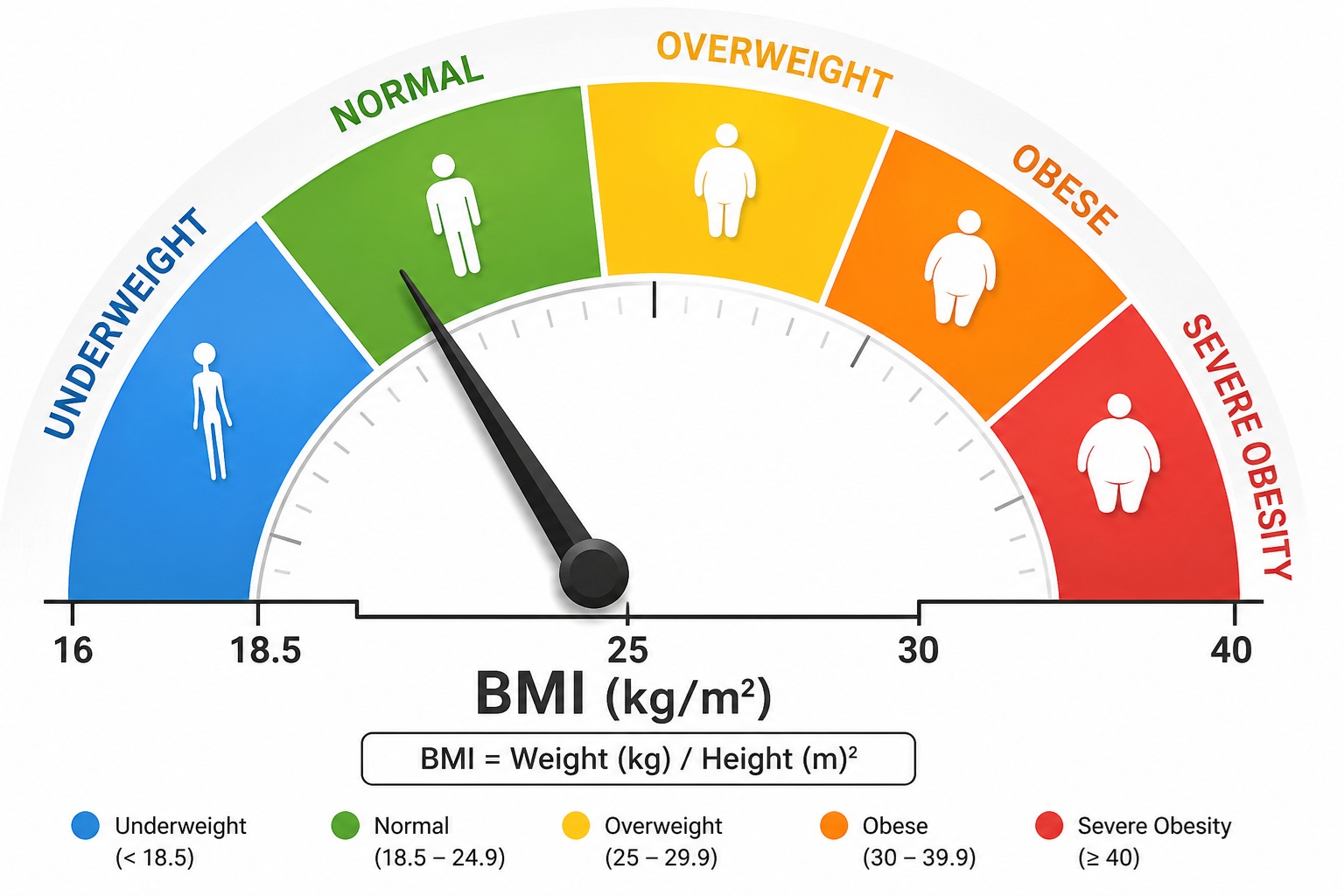
BMI Formula
BMI = Weight (kg) ÷ [Height (m)]²
Example: 70 ÷ (1.75 × 1.75) = 22.9 kg/m²
Height vs Healthy Weight Table (BMI 18.5–24.9)
Note: These healthy weight ranges are estimates based on a BMI between 18.5 and 24.9 for adults. Your ideal weight may vary depending on age, gender, muscle mass, body frame, and overall health. This table is for educational purposes and should not replace medical advice.
| Height | Height (cm) | Healthy Weight (kg) | Healthy Weight (lbs) |
| 4’10” | 147 | 40–54 | 88–119 |
| 4’11” | 150 | 42–56 | 93–123 |
| 5’0″ | 152 | 43–58 | 97–128 |
| 5’1″ | 155 | 45–60 | 100–132 |
| 5’2″ | 157 | 46–62 | 104–136 |
| 5’3″ | 160 | 47–64 | 107–141 |
| 5’4″ | 163 | 49–66 | 110–145 |
| 5’5″ | 165 | 50–68 | 114–149 |
| 5’6″ | 168 | 52–70 | 118–154 |
| 5’7″ | 170 | 54–72 | 121–159 |
| 5’8″ | 173 | 56–74 | 125–164 |
| 5’9″ | 175 | 57–77 | 128–169 |
| 5’10” | 178 | 59–79 | 132–174 |
| 5’11” | 180 | 61–81 | 136–179 |
| 6’0″ | 183 | 62–84 | 140–184 |
| 6’1″ | 185 | 64–86 | 144–189 |
| 6’2″ | 188 | 66–89 | 148–195 |
| 6’3″ | 191 | 68–91 | 152–200 |
| 6’4″ | 193 | 70–94 | 156–206 |
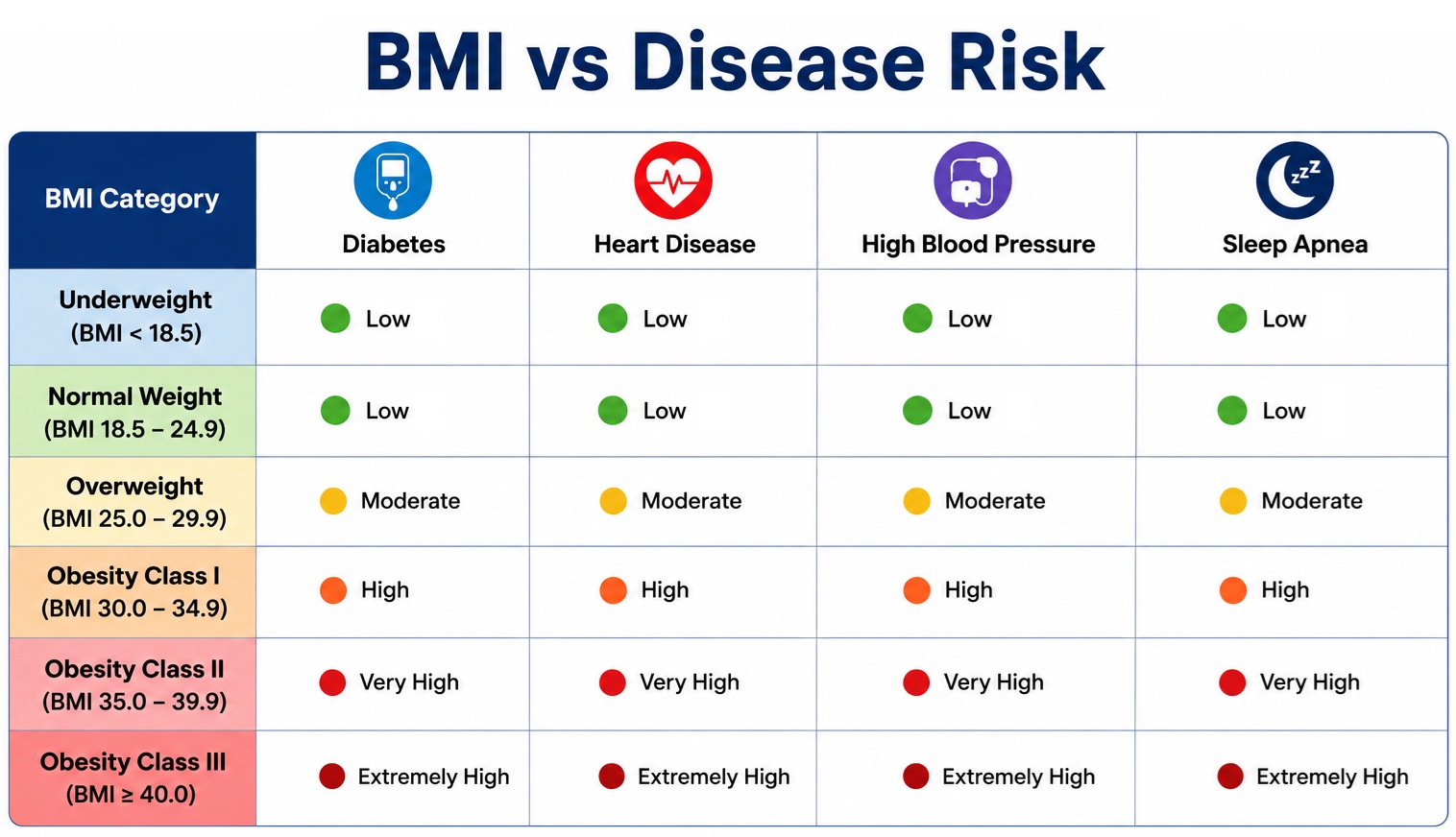
BMI vs Disease Risk Table
Note: This table shows the general trend of disease risk as BMI increases. BMI is only a screening tool and does not diagnose disease. Your actual risk also depends on factors such as age, family history, physical activity, diet, smoking, blood cholesterol, and overall health. People with a healthy BMI can still develop these conditions, while some people with a higher BMI may not. Regular checkups with a healthcare provider are important for a complete health assessment.
| BMI Category | BMI Range (kg/m²) | Type 2 Diabetes | Heart Disease | High Blood Pressure | Sleep Apnea |
| Underweight | Below 18.5 | Low | Low | Low | Low |
| Healthy Weight | 18.5–24.9 | Low | Low | Low | Low |
| Overweight | 25.0–29.9 | Moderate | Moderate | Moderate | Moderate |
| Obesity Class I | 30.0–34.9 | High | High | High | High |
| Obesity Class II | 35.0–39.9 | Very High | Very High | Very High | Very High |
| Obesity Class III | 40.0 and above | Extremely High | Extremely High | Extremely High | Extremely High |
BMI vs Body Fat Comparison
BMI and body fat are related, but they are not the same. BMI uses your height and weight to estimate whether your weight is healthy. It is quick and easy to calculate, but it cannot tell how much of your body is fat or muscle. Body fat percentage measures the amount of fat in your body and gives a better picture of body composition. For example, a muscular athlete may have a high BMI but a low body fat percentage. On the other hand, a person with a normal BMI may still have too much body fat. Using both BMI and body fat percentage together provides a better understanding of your overall health and fitness.
| BMI | Estimated Body Fat (Male) | Estimated Body Fat (Female) |
| 20 | 12–17% | 20–26% |
| 25 | 18–24% | 27–33% |
| 30 | 25–31% | 34–40% |
BMI Limitations
BMI is a useful tool for checking whether your weight is in a healthy range, but it is not perfect. It only uses your height and weight and does not measure body fat, muscle, or bone mass. For example, athletes with a lot of muscle may have a high BMI even though they are healthy. Older adults may have a normal BMI but still have too much body fat. BMI also does not consider age, sex, ethnicity, or where fat is stored in the body. Because of these limits, BMI should be used as a general screening tool.
| BMI Limitation | Explanation | Better Assessment |
| Does Not Measure Body Fat | BMI cannot tell how much of your weight is fat. | Body fat percentage |
| Cannot Measure Muscle Mass | Muscular people may have a high BMI but low body fat. | Body composition analysis |
| Ignores Bone Size | People with larger bones may weigh more naturally. | Clinical assessment |
| Does Not Consider Age | Body fat changes as people get older. | Age-specific health evaluation |
| Does Not Consider Sex | Men and women naturally have different body fat levels. | Sex-specific body fat ranges |
| Does Not Consider Ethnicity | Health risks at the same BMI can vary between populations. | Ethnicity-specific guidelines |
| Cannot Show Fat Distribution | BMI does not show where fat is stored in the body. | Waist circumference or waist-to-height ratio |
| Not Ideal for Athletes | Athletes often have more muscle, which increases BMI. | Body fat percentage or DEXA scan |
| Limited During Pregnancy | BMI is not designed to assess healthy weight during pregnancy. | Pregnancy weight gain guidelines |
| Not a Disease Diagnosis | A high BMI does not mean a person has a disease. | Medical examination and lab tests |
| Best Use | Works well as a quick screening tool for most adults. | Use together with other health measurements |
BMI Categories by WHO (World Health Organization)
The World Health Organization (WHO) uses Body Mass Index (BMI) to classify weight in adults. BMI is calculated using your height and weight. It helps identify whether a person is underweight, at a healthy weight, overweight, or has obesity. These categories are used by doctors and healthcare organizations around the world to screen for possible health risks. A healthy BMI is between 18.5 and 24.9 kg/m². People with a BMI above 25 may have a higher risk of conditions such as heart disease, type 2 diabetes, and high blood pressure. BMI is a useful screening tool, but it does not measure body fat directly. WHO recommends using BMI together with other health measurements for a better understanding of overall health.
WHO Adult BMI Categories Table
| WHO BMI Category | Weight Status | BMI Range (kg/m²) |
| Severe Thinness | Very Underweight | Below 16.0 |
| Moderate Thinness | Underweight | 16.0–16.9 |
| Mild Thinness | Slightly Underweight | 17.0–18.4 |
| Normal Weight | Healthy Weight | 18.5–24.9 |
| Overweight (Pre-obesity) | Overweight | 25.0–29.9 |
| Obesity Class I | Obesity | 30.0–34.9 |
| Obesity Class II | Severe Obesity | 35.0–39.9 |
| Obesity Class III | Morbid Obesity | 40.0 and above |
Frequently Asked Questions (FAQs)
1. What is a healthy BMI for adults?
A healthy BMI for most adults is 18.5 to 24.9 kg/m². This range is associated with the lowest risk of many weight-related health problems. BMI is only a screening tool and should be considered along with other health measurements.
2. What BMI is considered overweight?
According to the World Health Organization (WHO) and the Centers for Disease Control and Prevention (CDC), a BMI between 25.0 and 29.9 kg/m² is classified as overweight. People in this range may have a higher risk of developing health conditions such as type 2 diabetes and heart disease.
3. What BMI is considered obese?
A BMI of 30.0 kg/m² or higher is considered obesity. Obesity is divided into three classes based on BMI and is linked to an increased risk of several chronic diseases.
4. How is BMI calculated?
BMI is calculated by dividing your weight in kilograms by your height in meters squared.
Formula: BMI = Weight (kg) ÷ Height² (m²)
5. Is BMI the same as body fat?
No. BMI estimates whether your weight is in a healthy range based on your height and weight. It does not measure body fat, muscle, or bone mass. Body fat percentage provides a more accurate picture of body composition.
6. Can someone have a normal BMI but still have too much body fat?
Yes. Some people have a normal BMI but a high body fat percentage. This is sometimes called normal-weight obesity and may still increase the risk of health problems.
7. Why is BMI not always accurate?
BMI does not consider muscle mass, bone size, age, sex, ethnicity, or where fat is stored in the body. For this reason, healthcare providers often use BMI together with waist circumference and other health measurements.
8. Does the WHO use BMI categories?
Yes. The World Health Organization (WHO) uses BMI categories to classify adults as underweight, healthy weight, overweight, or obese. These categories are widely used by healthcare professionals around the world.
9. What diseases are linked to a high BMI?
A high BMI is associated with a greater risk of type 2 diabetes, heart disease, high blood pressure, stroke, sleep apnea, osteoarthritis, and some types of cancer. However, BMI alone cannot diagnose any disease.
10. Should I use BMI or body fat percentage?
Both are useful. BMI is a quick and easy screening tool, while body fat percentage gives more information about body composition. Using both together provides a better understanding of your overall health.
References
-
Centers for Disease Control and Prevention (CDC).
About Body Mass Index (BMI).
https://www.cdc.gov/bmi/about/ -
World Health Organization (WHO).
Obesity and Overweight Fact Sheet.
https://www.who.int/news-room/fact-sheets/detail/obesity-and-overweight -
National Heart, Lung, and Blood Institute (NHLBI) – NIH (.gov).
Classification of Overweight and Obesity by BMI.
https://www.ncbi.nlm.nih.gov/books/NBK2004/table/A239/ -
Harvard T.H. Chan School of Public Health (.edu).
Obesity Prevention Source – Body Weight and Health.
https://www.hsph.harvard.edu/obesity-prevention-source/ -
Johns Hopkins Bloomberg School of Public Health (.edu).
Obesity and Public Health Resources.
https://publichealth.jhu.edu/