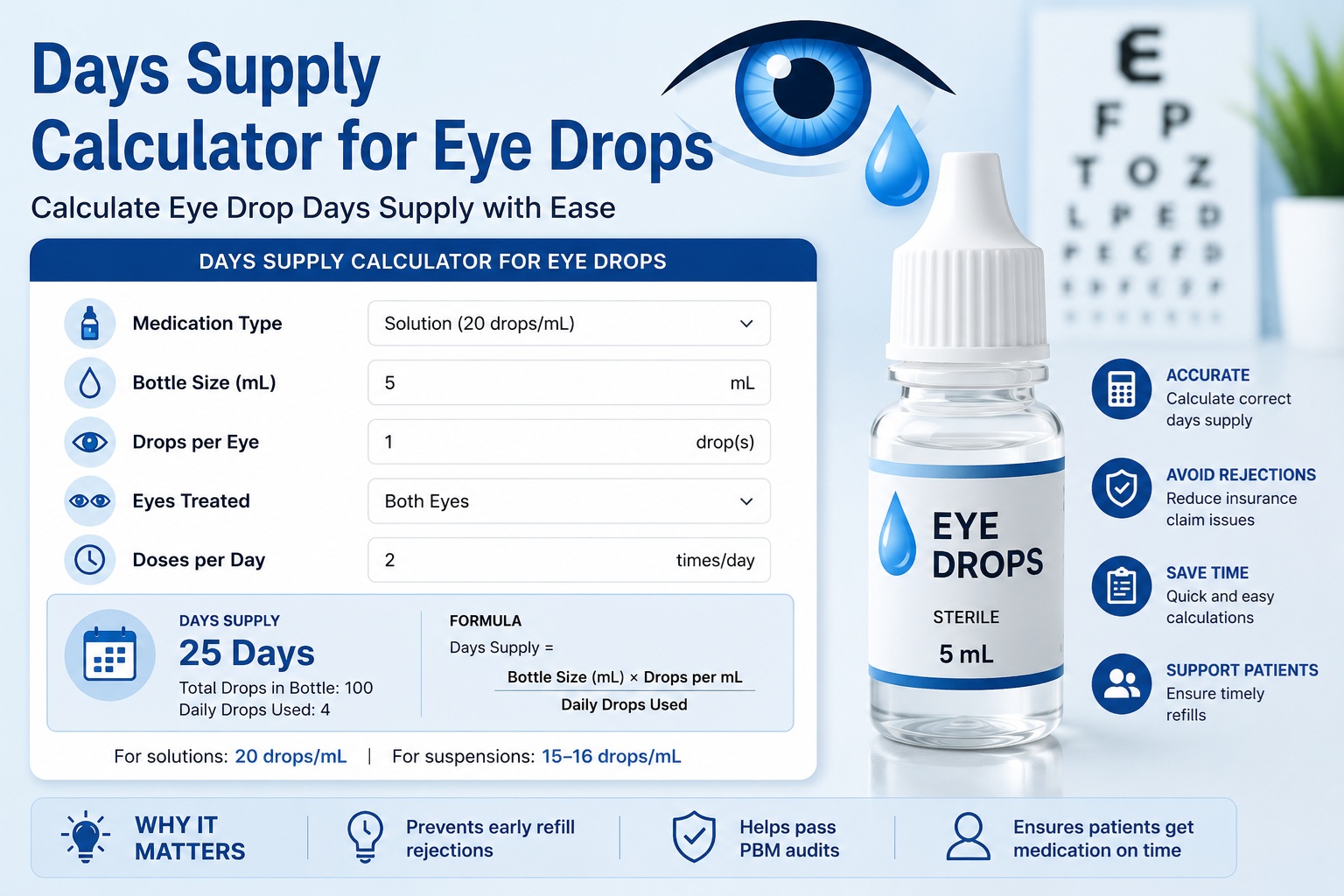
Days Supply Calculator (Eye Drops) for Healthcare Needs
Day Supply Formula for Eye Drops
👁️ Eye Drop Days Supply Calculator
📦 Bottle Package Size (ml)
💧 Drops per mL
👁️ Directions to Use
📌 Please Note:
✔ Default Number of Drops in Solution are 20 drops per mL
✔ Default Number of Drops in Suspension are 16 drops per mL
✔ (L/R) – Left or Right Eye
📊 Instant Results
📐 Step by Step Calculations
⚙️ Adjust inputs above → real-time calculation
How to Use this calculator?
- Bottle Package Size: Select the package size of the Eye Drop Bottle, as requested by healthcare provider. You can feed any available drug packaging size for eg: 2.5ml, 3.5ml, 5ml or 10ml.
- Drops per mL : You can choose any number of drops per mL. By default it is generally recommended to use 20 drops per Ml if medication is available in solution form. For suspensions being a little thick usually insurances accept 16 drops/mL. However its upto the individual what drop size they chose to calculate.
- Special Instructions / Directions: This area represent the frequency of medication at which drug should be administered into the eye. It can be 1 drop in left eye or right eye or both eyes.
Once you’ve entered these details, the calculator will provide you with the estimated number of days your medication supply will last. This information empowers you to plan your refills well in advance, ensuring you always have your medications on hand when you need them.
Our Popular Calculators
- Adults ADHD Symptoms Test
- Amoxicillin Dose Calculator
- Bi-Est Compounding Calculator
- Tri-Est Compounding Calculator
- BMI Calculator
- Clarks Rule Calculator
- Elemental Iron Calculator
- Ear Drops Day Supply
- Eye Drops Day Supply
- Ibuprofen Dose Calculator
- Insulin Calculator
- Tablet Daily Supply
- Tri-Est Compounding Calculator
- Infant Tylenol Dosage Calculator
Understanding Day Supply Calculator (Eye Drops)
The Eye Drops Day Supply Calculator is a specialized digital tool tailored to determine the duration of an eye medication supply based on the prescribed dosage and the quantity of eye drops in a prescription. This invaluable tool ensures precision and efficiency in managing eye-related health conditions.
In the world of healthcare, precision and efficiency are paramount. When it comes to eye medications, accuracy in dosage and supply is crucial for both patients and healthcare providers. Enter the Eye Drops Day Supply Calculator – a tool designed to simplify medication management, benefiting not only patients but also pharmacy professionals, nurses, pharmacy technicians, and healthcare providers. In this article, we’ll explore the advantages of this calculator and how it streamlines processes for everyone involved.
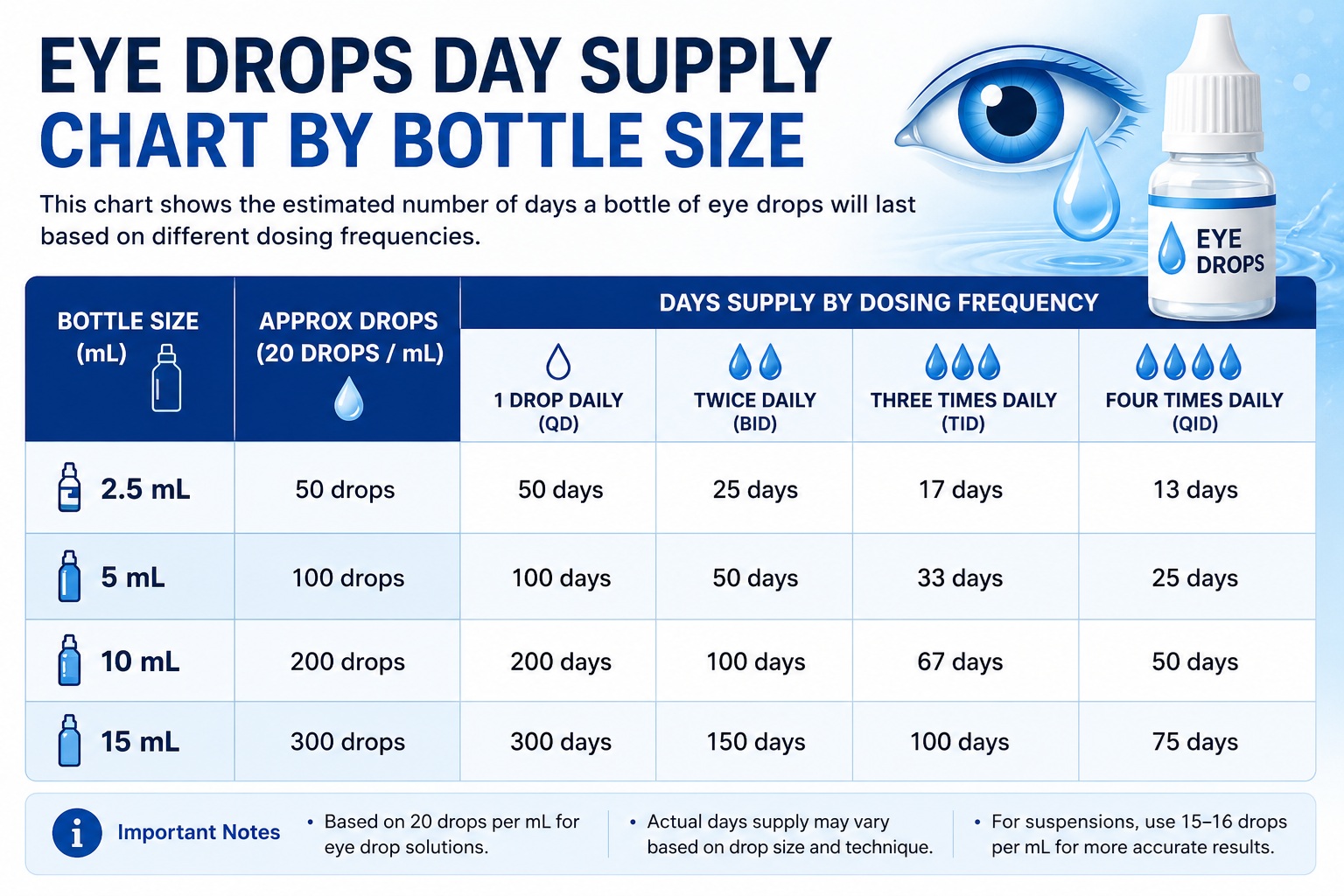
Eye Drops Day Supply Chart by Bottle Size
This section alone can rank for dozens of long-tail keywords.
Example table:
| Bottle Size | Approx Drops (20/mL) | 1 Drop Daily | BID | TID | QID |
| 2.5 mL | 50 | 50 days | 25 days | 17 days | 13 days |
| 5 mL | 100 | 100 days | 50 days | 33 days | 25 days |
| 10 mL | 200 | 200 days | 100 days | 67 days | 50 days |
| 15 mL | 300 | 300 days | 150 days | 100 days | 75 days |
Most Common Eye Drop Medications
Different eye drops come in different bottle sizes and are used to treat different eye conditions such as glaucoma, dry eyes, allergies, infections, and inflammation. The number of days a bottle lasts depends on the bottle size, how many drops are used each day, whether you treat one or both eyes, and the prescribed dosing schedule.
The table below shows common eye drop medications, their typical bottle sizes, the type of formulation, and an estimated days supply for an average patient. Actual days supply may vary based on your prescription.
| Medication | Common Bottle Size | Type | Typical Days Supply* |
| Latanoprost | 2.5 mL | Solution | 30 Days |
| Travoprost | 2.5 mL | Solution | 30 Days |
| Bimatoprost | 2.5 mL | Solution | 30 Days |
| Timolol | 5 mL | Solution | 25–50 Days |
| Brimonidine | 5 mL | Solution | 25–35 Days |
| Dorzolamide | 10 mL | Solution | 30–50 Days |
| Dorzolamide/Timolol | 10 mL | Solution | 30–50 Days |
| Prednisolone Acetate 1% | 5 mL | Suspension | 10–20 Days |
| Ketorolac | 5 mL | Solution | 15–30 Days |
| Ciprofloxacin Ophthalmic | 5 mL | Solution | 7–14 Days |
| Moxifloxacin Ophthalmic | 3 mL | Solution | 7–14 Days |
| Tobramycin | 5 mL | Solution | 7–14 Days |
| Olopatadine | 5 mL | Solution | 30–60 Days |
| Azelastine | 6 mL | Solution | 30–45 Days |
| Cyclosporine (Restasis®) | Single-Use Vials | Emulsion | 30 Days |
| Cyclosporine (Cequa®) | Single-Use Vials | Solution | 30 Days |
| Lifitegrast (Xiidra®) | Single-Use Vials | Solution | 30 Days |
| Artificial Tears | 10–15 mL | Solution | 30–90 Days |
| Lubricating Eye Gel | 10 g Tube | Gel | 30–60 Days |
Solutions vs. Suspensions: Why It Matters for Eye Drop Days Supply
When calculating the days supply for eye drops, one important factor is whether the medication is a solution or a suspension. These two types of eye drops have different thicknesses, which affects how many drops are dispensed from each milliliter (mL) of medication.
Understanding the difference helps patients, pharmacists, healthcare providers, and insurance companies calculate a more accurate eye drop days supply.
Solution Eye Drops
A solution is a clear liquid in which the medication is completely dissolved. Because solutions are thinner, they produce more drops per milliliter than suspensions.
Common characteristics of solution eye drops:
- Thin, clear liquid
- Medication is fully dissolved
- Typically 20 drops per mL
- More consistent drop size
- Commonly used for glaucoma, allergy, antibiotic, and lubricating eye drops
Examples of solution eye drops:
- Latanoprost
- Timolol
- Brimonidine
- Dorzolamide
- Olopatadine
- Moxifloxacin
Suspension Eye Drops
A suspension contains tiny medication particles that are mixed throughout the liquid instead of being completely dissolved. Since suspensions are thicker, they produce fewer drops per milliliter.
Common characteristics of suspension eye drops:
- Thicker liquid
- Medication particles settle over time
- Bottle should be shaken well before each use
- Typically 15–16 drops per mL
- Often used for steroid and anti-inflammatory eye medications
Examples of suspension eye drops:
- Prednisolone Acetate 1%
- Loteprednol
- Fluorometholone
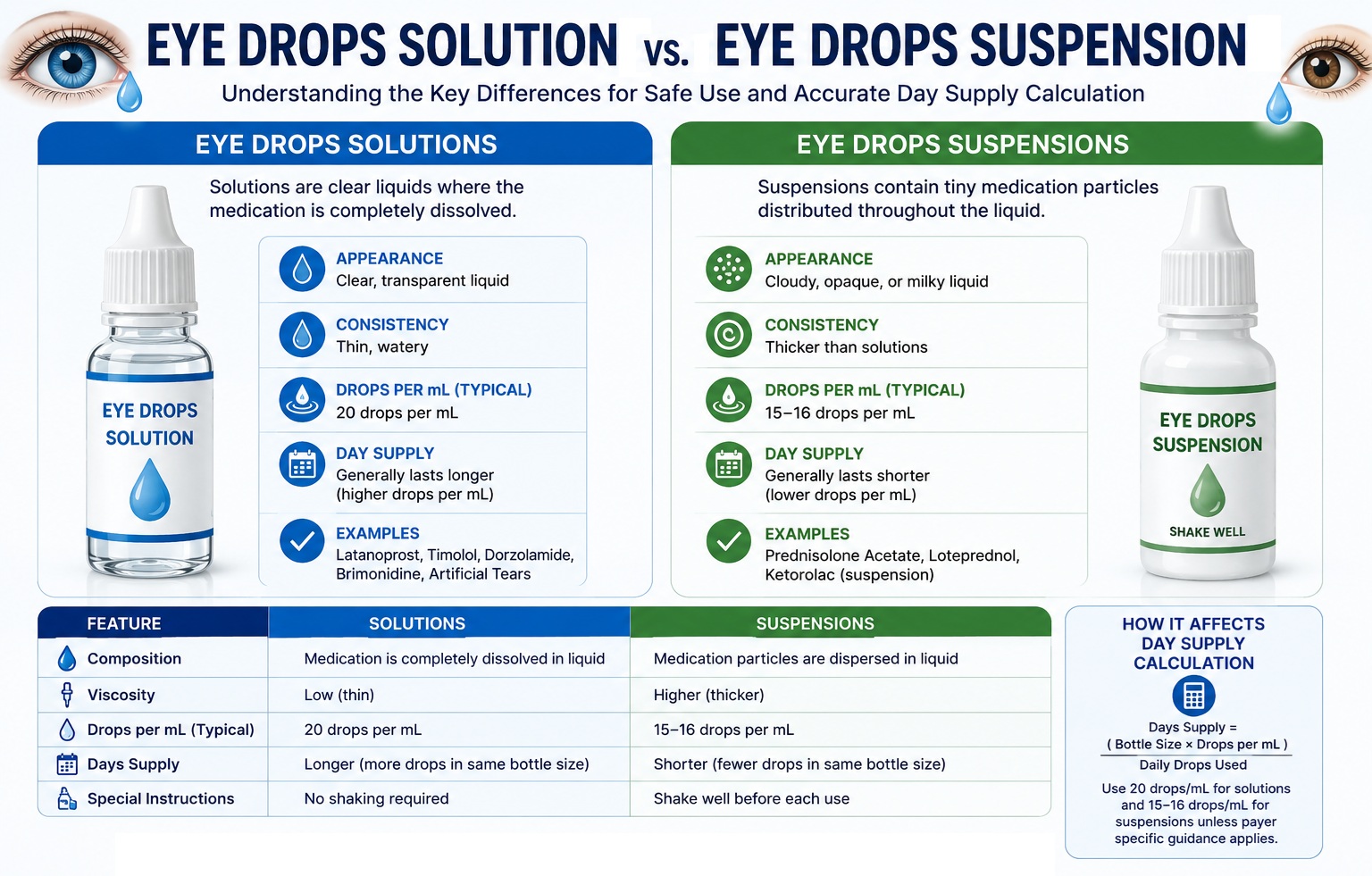
Eye Drops Solution vs. Suspension Comparison
| Feature | Solution | Suspension |
| Consistency | Thin | Thicker |
| Medication | Completely dissolved | Tiny particles suspended in liquid |
| Typical Drops per mL | 20 drops/mL | 15–16 drops/mL |
| Shake Before Use | No | Yes |
| Common Uses | Glaucoma, allergy, antibiotics, dry eye | Steroids and anti-inflammatory medications |
| Days Supply | Usually lasts longer per bottle | Usually lasts fewer days per bottle |
Why This Difference Matters
The number of drops per milliliter directly affects the eye drop days supply calculation. Since solution eye drops produce more drops from the same bottle size, they generally last longer than suspension eye drops.
For example:
- 5 mL solution: Approximately 100 drops (20 drops × 5 mL)
- 5 mL suspension: Approximately 75–80 drops (15–16 drops × 5 mL)
If you use 2 drops per day, the solution bottle may last about 50 days, while the suspension bottle may last only 38–40 days.
Why Insurance Companies Use Different Conversion Factors
Many insurance companies, Medicare Part D plans, and pharmacy benefit managers (PBMs) use different conversion factors when determining the days supply for eye drop prescriptions. A solution is often calculated using 20 drops per mL, while a suspension may be calculated using 15 or 16 drops per mL.
Using the correct conversion factor helps:
- Process insurance claims accurately.
- Prevent rejected pharmacy claims.
- Ensure patients receive the correct refill date.
- Avoid running out of medication too early.
- Improve accuracy when calculating eye drop days supply.
Important: The actual number of drops per mL can vary by manufacturer, bottle design, dropper tip, and the medication’s viscosity. The values of 20 drops/mL for solutions and 15–16 drops/mL for suspensions are commonly used estimates for pharmacy calculations and insurance billing. Always follow your prescriber’s instructions and your payer’s guidelines when determining days supply.
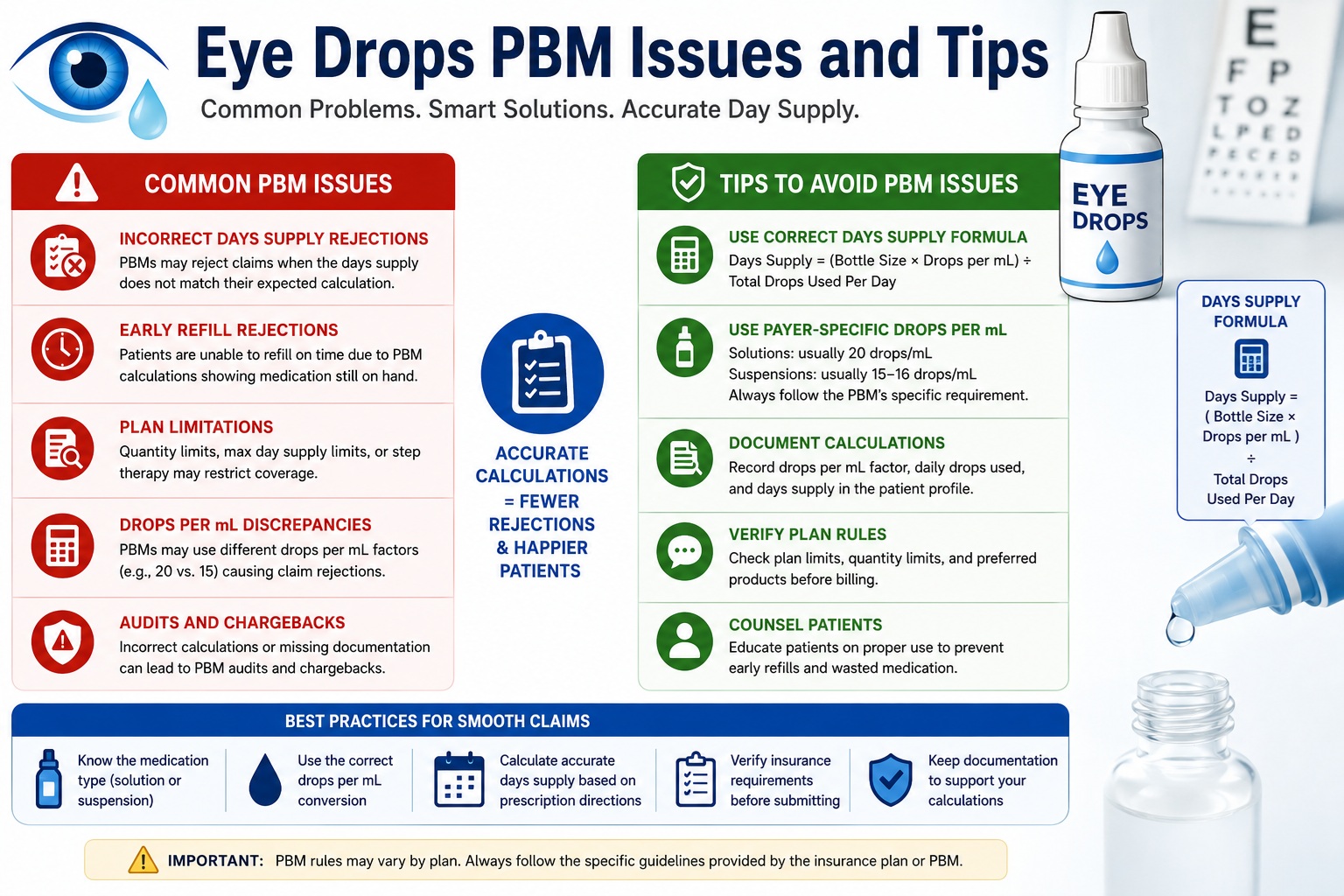
PBM Billing Tips for Eye Drop Prescriptions
Pharmacy Benefit Managers (PBMs) carefully review eye drop prescription claims to make sure the days supply matches the prescribed directions. If the days supply is incorrect, pharmacies may receive claim rejections, delayed payments, or audit findings.
Understanding how PBMs calculate eye drop days supply can help pharmacists submit more accurate claims and reduce billing problems.
Why Do PBMs Audit Eye Drop Claims?
PBMs audit eye drop prescriptions because eye drops are different from tablets and capsules. The amount of medication in a bottle is measured in milliliters (mL), but patients use drops, not milliliters.
During an audit, PBMs may check:
- The prescribed directions (SIG)
- Bottle size
- Number of drops used each day
- Whether one eye or both eyes are being treated
- The days supply submitted on the claim
Pharmacy documentation
If the submitted days supply does not match the prescription, the claim may be questioned.
Incorrect Days Supply Can Cause Problems
One of the most common billing mistakes is submitting the wrong days supply.
For example, if a bottle should last 30 days but the claim is submitted for 20 days, the patient may be allowed to refill the medication too early. If the claim is submitted for 45 days when the bottle only lasts 30 days, the refill may be rejected when the patient needs more medication.
Using the correct days supply helps:
- Reduce claim errors
- Prevent PBM audit issues
- Improve payment accuracy
- Make sure patients receive refills on time
Why Early Refill Rejections Happen
An early refill rejection occurs when an insurance plan believes the patient still has enough medication left.
Common reasons include:
- Incorrect days supply entered on the original claim
- Wrong bottle size selected
- Incorrect drop conversion factor
- Prescription directions changed without updating the claim
- Patient using drops in both eyes instead of one eye
Calculating the correct days supply the first time can help prevent unnecessary refill delays.
Use the Correct Drop Conversion Factor
The drop conversion factor is one of the most important parts of an eye drop days supply calculation.
The commonly used estimates are:
| Eye Drop Type | Typical Drops per mL |
| Solution | About 20 drops/mL |
| Suspension | About 15–16 drops/mL |
Using the wrong conversion factor can change the calculated days supply and may lead to billing problems or audit findings.
Tip: Always follow your PBM, insurance plan, or employer’s billing guidelines. Some plans have specific rules for calculating eye drop days supply, and these rules may differ from standard pharmacy estimates.
Best Practices for Accurate PBM Billing
Following a few simple steps can help improve claim accuracy:
- Calculate the days supply before submitting the claim.
- Verify whether the medication is a solution or a suspension.
- Confirm if the patient is treating one eye or both eyes.
- Double-check the bottle size and prescription directions.
- Keep clear documentation for any unusual dosing or early refill requests.
- Follow your PBM or insurance plan’s billing guidelines whenever they differ from standard calculations.
By using accurate calculations and maintaining good records, pharmacies can reduce claim rejections, pass PBM audits more easily, and help patients receive their eye drop medications without unnecessary delays.
Real Life Practice Question
Eye Drop Solution Days Supply Question
A patient is prescribed Latanoprost 0.005% ophthalmic solution.
Prescription:
- Instill 1 drop into both eyes every evening
- Bottle size: 2.5 mL
- Assume the solution produces 20 drops per mL
Question: What is the correct days supply?
Step 1: Calculate Total Drops in the Bottle
- Bottle Size × Drops per mL
- 2.5 mL × 20 drops = 50 drops
- Total drops available = 50 drops
Step 2: Calculate Daily Drop Usage
The patient uses:
- 1 drop in the left eye
- 1 drop in the right eye
Total daily use = 2 drops/day
Step 3: Calculate Days Supply
Days Supply = Total Drops ÷ Drops Used Per Day
50 ÷ 2 = 25 days
Answer: Days Supply = 25 days
Formula Used: Days Supply = (Bottle Size × Drops per mL) ÷ Total Drops Used Per Day
Eye Drop Suspension Days Supply Question
A patient is prescribed Prednisolone Acetate 1% ophthalmic suspension.
Prescription:
- Instill 1 drop into both eyes four times daily
- Bottle size: 10 mL
- Assume the suspension produces 15 drops per mL
Question: What is the correct days supply?
Step 1: Calculate Total Drops in the Bottle
- Bottle Size × Drops per mL
- 10 mL × 15 drops = 150 drops
- Total drops available = 150 drops
Step 2: Calculate Daily Drop Usage
The patient uses:
- 1 drop × 2 eyes × 4 times daily
- 1 × 2 × 4 = 8 drops/day
Step 3: Calculate Days Supply
Days Supply = Total Drops ÷ Drops Used Per Day
150 ÷ 8 = 18.75 days
Pharmacies typically round down to the nearest whole day for billing purposes.
Answer: Days Supply = 18 days or 19 days
Formula Used: Days Supply = (Bottle Size × Drops per mL) ÷ Total Drops Used Per Day
Key Takeaway
- Solutions are thinner and typically provide 20 drops per mL, so they generally last longer.
- Suspensions are thicker and typically provide 15 drops per mL, so the same bottle size usually has fewer drops and a shorter days supply.
- Always use the correct drops per mL conversion factor, the bottle size, and the prescribed dosing instructions to calculate an accurate eye drop days supply.
Frequently Asked Questions About Eye Drop Days Supply
1. How many drops are in a 5 mL eye drop bottle?
A typical 5 mL eye drop solution contains about 100 drops (20 drops per mL). A 5 mL suspension usually contains about 75–80 drops because suspensions produce fewer drops per milliliter.
2. How do pharmacies calculate eye drop day supply?
Pharmacies calculate eye drop days supply by multiplying the bottle size by the estimated drops per mL and dividing by the total number of drops used each day. Formula: Days Supply = (Bottle Size × Drops per mL) ÷ Daily Drops Used.
3. How many drops are in 1 mL?
For most pharmacy calculations, ophthalmic solutions contain about 20 drops per mL, while ophthalmic suspensions contain about 15 to 16 drops per mL. The exact number varies by manufacturer.
4. Why do suspensions use fewer drops per mL?
Suspensions are thicker than solutions and produce larger drops. As a result, they typically contain only 15–16 drops per mL compared to about 20 drops per mL for solutions.
5. How long should a 5 mL bottle last?
The number of days depends on your prescription. For example, if you use one drop in both eyes once daily, a 5 mL solution containing about 100 drops will typically last about 50 days.
6. How many days is a 2.5 mL bottle?
A 2.5 mL solution contains about 50 drops. If you use one drop in both eyes once daily, the bottle will typically last about 25 days.
7. Does Medicare use 20 drops per mL?
Many Medicare Part D plans and insurance companies commonly use 20 drops per mL for eye drop solutions and 15–16 drops per mL for suspensions. However, individual plan rules may vary.
8. Can insurance reject eye drop prescriptions?
Yes. Insurance companies may reject eye drop claims if the days supply is incorrect, the refill request is too early, or the claim does not match the prescription directions.
9. How many drops are used in both eyes twice daily?
If the prescription is one drop in both eyes twice daily, the patient uses four drops per day (1 drop × 2 eyes × 2 doses).
10. What is the formula for calculating eye drops?
The standard formula is: Days Supply = (Bottle Size × Drops per mL) ÷ Total Drops Used Per Day. This formula is commonly used by pharmacies for insurance billing.
11. What is an eye drop days supply calculator?
An eye drop days supply calculator estimates how long an eye drop bottle will last based on bottle size, medication type, number of eyes treated, and daily dosing frequency.
12. Why is eye drop days supply important?
An accurate days supply helps reduce insurance claim rejections, prevents early refill problems, supports PBM audits, and ensures patients receive medication on time.
13. Do all eye drop bottles contain the same number of drops?
No. The number of drops depends on the bottle design, manufacturer, medication viscosity, and whether the product is a solution or suspension.
14. Should eye drop suspensions be shaken before use?
Yes. Most ophthalmic suspensions should be shaken well before each use to evenly distribute the medication particles throughout the liquid.
15. How do I calculate daily eye drop use?
Multiply the number of drops per eye by the number of eyes treated and the number of doses per day. Example: 1 drop × 2 eyes × 3 times daily = 6 drops per day.
16. Why do PBMs audit eye drop prescriptions?
PBMs audit eye drop claims to verify that the submitted days supply matches the prescription directions, bottle size, and accepted drop conversion factors.
17. What is the difference between eye drop solutions and suspensions?
Solutions are thin liquids with the medication completely dissolved and usually contain about 20 drops per mL. Suspensions are thicker liquids with medication particles and usually contain about 15–16 drops per mL.
18. Can the number of drops per mL vary by manufacturer?
Yes. Different manufacturers and bottle designs may produce different drop sizes. The commonly used values of 20 drops per mL for solutions and 15–16 drops per mL for suspensions are standard pharmacy estimates.
19. Why is my eye drop refill being rejected too early?
Early refill rejections usually occur when the insurance plan believes you still have medication remaining. This often happens because of an incorrect days supply or changes in the prescription directions.
20. How can I avoid eye drop billing errors?
Use the correct bottle size, identify whether the medication is a solution or suspension, calculate the correct daily drop usage, apply the proper drops-per-mL conversion factor, and document your calculations for PBM and insurance audits.
References
-
American Academy of Ophthalmology (AAO) – Eye Health
Comprehensive patient and professional information on eye diseases, prescription eye drops, glaucoma medications, proper eye drop administration, and ophthalmic treatments. -
EyeWiki – American Academy of Ophthalmology
Peer-reviewed ophthalmology reference covering ophthalmic medications, eye drop formulations, dosing recommendations, and clinical treatment guidelines. -
National Eye Institute (NEI) – Learn About Eye Health
Official educational resource from the National Eye Institute providing evidence-based information about eye diseases, vision care, eye medications, and treatment options. -
Prevent Blindness – Eye Health & Vision Resources
Nonprofit organization offering educational materials on eye health, medication safety, vision preservation, and proper eye drop use for patients. -
Kentucky Pharmacists Association (PAAS National®) – Days' Supply Considerations for Eye Medications
Provides pharmacy billing guidance for calculating eye drop days supply, including commonly used conversion factors of 20 drops/mL for ophthalmic solutions and 15 drops/mL for ophthalmic suspensions when PBM-specific guidance is unavailable.