
Biest Calculator for Estriol (E3) and Estradiol (E2) Ratio
Biest Ratio Formula
Biest Ratio (E3:E2) = Amount of Estriol (E3) ÷ Amount of Estradiol (E2)
Example: E3 = 2 mg, E2 = 0.5 mg
Ratio = 4:1
Bi-est Compounding Calculator
Calculate Estriol (E3) and Estradiol (E2) amounts based on concentration and ratio
Calculation Results
Estriol (E3)
Estradiol (E2)
Total Summary
Our Popular Calculators
- Adults ADHD Symptoms Test
- Amoxicillin Dose Calculator
- Bi-Est Compounding Calculator
- Tri-Est Compounding Calculator
- BMI Calculator
- Clarks Rule Calculator
- Elemental Iron Calculator
- Ear Drops Day Supply
- Eye Drops Day Supply
- Ibuprofen Dose Calculator
- Insulin Calculator
- Tablet Daily Supply
- Tri-Est Compounding Calculator
- Infant Tylenol Dosage Calculator
How our Bi-est compounding calculator works?
Our Bi-est compounding calculator simplifies the process of determining exact hormone amounts in your prescribed formulation. The tool requires three key inputs:
- First, enter your Bi-est concentration in mg/ml: this represents how much total estrogen is present in each milliliter of your preparation (e.g., 2 mg/ml means 2 milligrams of combined E3 and E2 per milliliter).
- Second, select your prescribed E3:E2 ratio from the available options ranging from 90:10 to 10:90. This determines what percentage of the total estrogen is estriol versus estradiol.
- Third, input the total amount you plan to use (in milliliters). This could represent your daily dose, weekly application, or any volume you need to calculate.
The calculator then performs three-step mathematics: it multiplies concentration by total amount to determine total estrogen content, calculates the E3 portion based on the first ratio number, and calculates the E2 portion based on the second ratio number.
Results display both in milligrams and grams including percentages of the total, providing clear understanding of exactly how much of each hormone component you’re receiving.
This tool serves educational purposes to help patients understand their hormone therapy and also it helps compounding pharmacist to calculate exact amount to be made. Understanding your specific Bi-est formulation empowers you to have more informed discussions with your provider about symptom management and therapy optimization.
What Is Biest Hormone Therapy?
Definition:
Biest hormone therapy is a type of hormone treatment made from two forms of estrogen: estriol (E3) and estradiol (E2). These hormones are mixed in a specific ratio, often 80:20 or 50:50, depending on a person’s needs. Biest is usually called a “bioidentical hormone,” which means it is designed to be very similar to the hormones naturally made by the human body. It can come in different forms like creams, capsules, or lozenges. Doctors may adjust the dose based on symptoms and lab results. The goal of Biest therapy is to help balance hormone levels in a more natural way compared to some traditional hormone treatments.
Most common Bi-est formulations
Bi-est 50:50
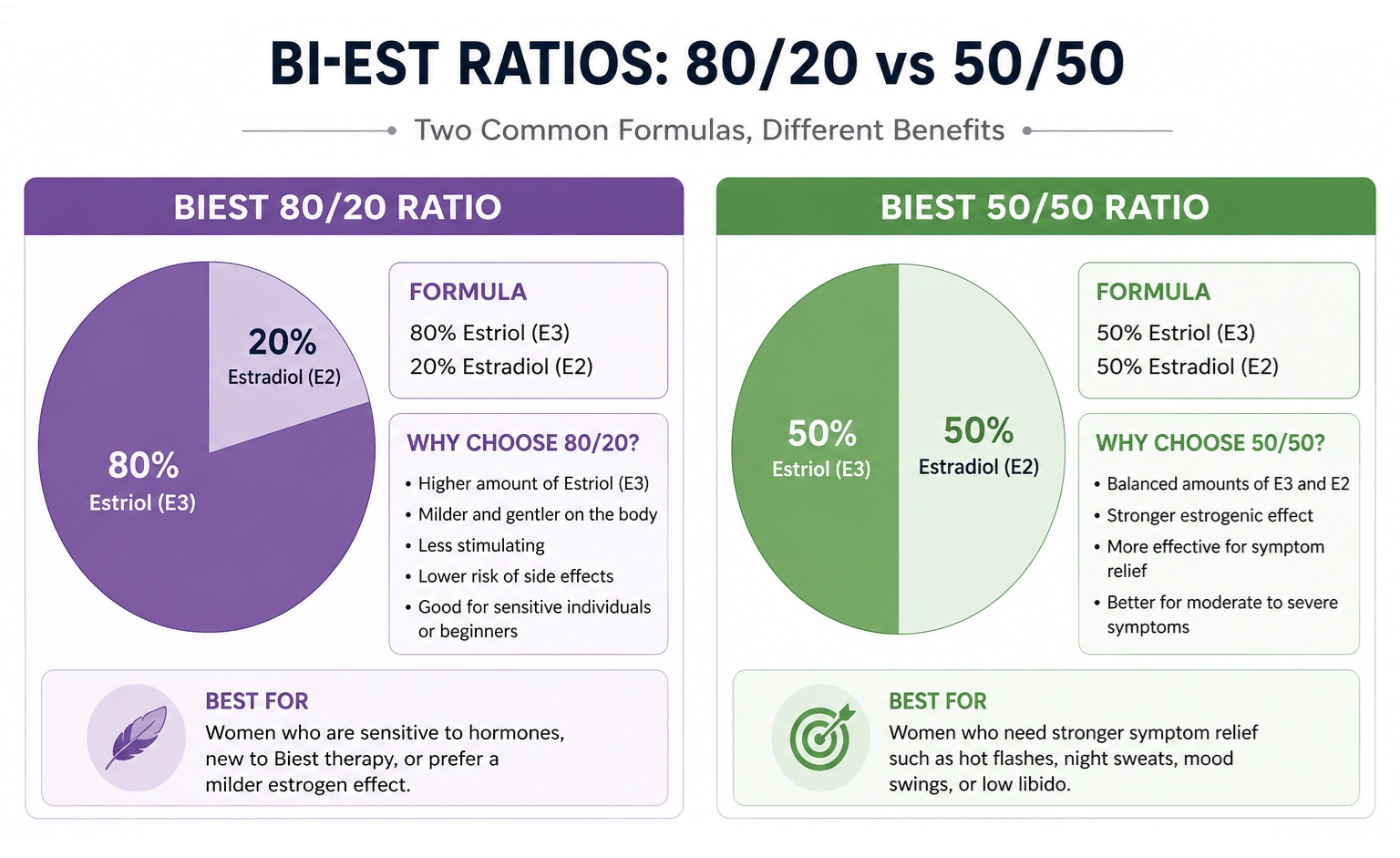
Bi-Est 50:50 is a common hormone therapy that contains two forms of estrogen: estriol (50%) and estradiol (50%). This balanced estrogen ratio is often used in bioidentical hormone replacement therapy (BHRT) for women. Doctors may recommend Bi-Est 50:50 to help manage menopause symptoms like hot flashes, night sweats, mood swings, vaginal dryness, and low energy.
The 50:50 estrogen blend is popular because it offers a mix of gentle and strong estrogen support. Estriol together with estradiol is more powerful. Together, they help support hormone balance, bone health, and overall women’s wellness.
Many women choose Bi-Est because it is custom compounded and designed to closely match the body’s natural hormones.
The Bi-Est 80:20
Bi-Est 80:20 is a popular form of bioidentical hormone replacement therapy (BHRT) used for women. It contains 80% estriol and 20% estradiol. Many doctors prefer the 80:20 ratio because estriol is a gentler and weaker estrogen, making it safer for long-term use. Estradiol is stronger, so using a smaller amount helps reduce side effects.
Bi-est 80:20 ratio is often preferred over Bi-Est 50:50 because it provides estrogen support with lower estrogen strength. This makes it a good choice for women who are sensitive to hormones or want a more natural balance. It is commonly used to help with menopause symptoms such as hot flashes, night sweats, vaginal dryness, and mood changes.
Bi-est Compounding Benefits or Clinical Use
The main benefit of Bi-est is that it can be custom-made just for you.
With regular hormone medicines, you get a standard formula that’s the same for everyone. But with Bi-est, a compounding pharmacist and your provider can work together to modify E3 and E2 amounts to match exactly what your body needs, based on your symptoms, health history, lab values. and how you feel. This personalized mix often works better for relieving symptoms and may cause fewer side effects.
Many doctors or providers like Bi-est for menopause treatment because:
- Estriol (E3) may help protect breast tissue
- Estradiol (E2) still helps with hot flashes, night sweats, vaginal dryness, and other menopause problems
Also, since Bi-est is made specially for you, it doesn’t have to contain:
- Artificial dyes
- Preservatives
- Common allergens
This makes it a good choice for people with sensitivities or allergies to ingredients in regular store-bought medicines.
Why the Estriol (E3) to Estradiol (E2) Ratio Matters
Hormone potency differences
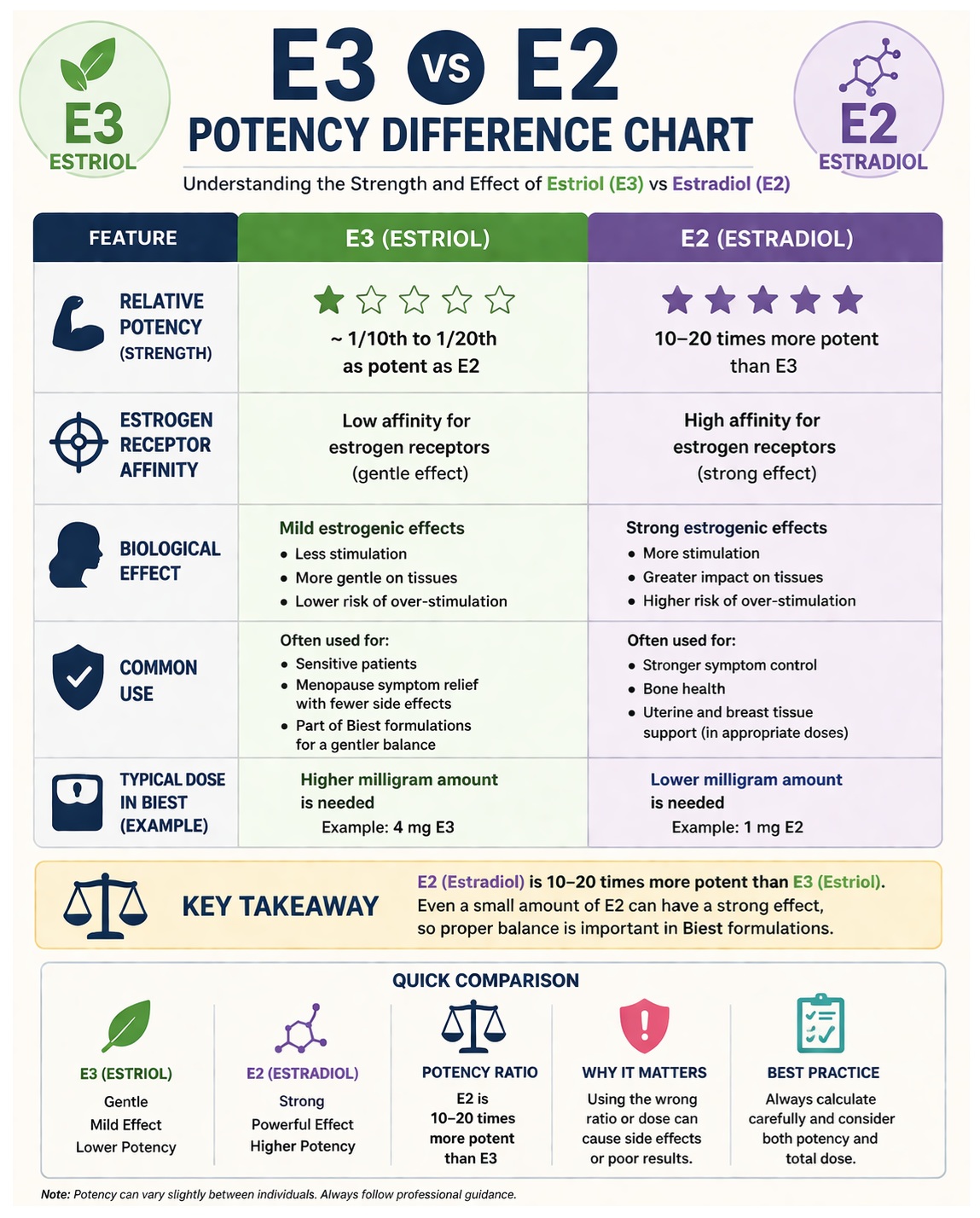
Estriol (E3) and Estradiol (E2) are both forms of estrogen, but they do not act the same in the body. E2 is much stronger and has a bigger effect on tissues like the uterus, breasts, and bones. E3 is weaker, which means it gives a gentler effect. Because of this, the ratio between E3 and E2 is very important in hormone therapy. A higher E3 ratio means a milder approach, while more E2 increases the strength of the treatment.
Safety considerations
E3 is often seen as safer because it does not strongly stimulate tissues the way E2 does. This may lower the risk of side effects when used correctly. On the other hand, E2 is more powerful, so it can carry higher risks if the dose is too high or not balanced well. That is why many providers carefully adjust the E3:E2 ratio to improve safety while still giving benefits.
Symptom control
Both hormones help relieve symptoms like hot flashes, mood swings, and vaginal dryness. E2 works faster and stronger, so it may be better for severe symptoms. E3 works more gently and is often used for long-term balance. The right ratio helps control symptoms while avoiding unnecessary risks.
Clinical Interpretation of Your Results
When you look at your hormone results, numbers alone don’t tell the full story. You also need to think about how you feel. Lab values give a guide, but symptoms help explain what is really happening in your body.
What High E2 Means
High estradiol (E2) is the stronger estrogen. When it is too high, you may feel breast tenderness, mood swings, headaches, or water retention. Some people also notice anxiety or trouble sleeping. It can feel like your body is “overstimulated.”
What High E3 Means
Estriol (E3) is a weaker and gentler estrogen. Higher E3 is usually better tolerated. It may support vaginal health, skin, and comfort. But if it gets too high compared to E2, it may not give enough strong estrogen effect, leading to fatigue or low mood.
When Ratios May Need Adjustment
The E3:E2 ratio matters a lot. If symptoms don’t match your lab results, your ratio may need adjusting. For example, too much E2 compared to E3 can cause strong side effects, while too little E2 may not relieve symptoms.
Biest Ratio vs Effect (Estriol vs Estradiol)
| Biest Ratio (E3:E2) | Estriol (E3) Level | Estradiol (E2) Level | Clinical Effect | Common Use |
|---|---|---|---|---|
| 80:20 | High | Low | Gentle estrogen effect, safer profile | First-line menopause therapy |
| 70:30 | Moderate-High | Moderate | Balanced symptom relief | General hormone therapy |
| 50:50 | Equal | Equal | Stronger estrogenic effect | Severe symptoms |
| 20:80 | Low | High | High potency, increased risk | Rare clinical use |
Biest Dosage Conversion (Estriol mg vs Estradiol mg)
| Estriol (E3) mg | Estradiol (E2) mg | Calculated Ratio | Equivalent % (E3:E2) |
|---|---|---|---|
| 2.0 mg | 0.5 mg | 4:1 | 80% : 20% |
| 3.5 mg | 1.5 mg | 2.3:1 | 70% : 30% |
| 1.0 mg | 1.0 mg | 1:1 | 50% : 50% |
| 0.5 mg | 2.0 mg | 1:4 | 20% : 80% |
Common Biest Prescriptions (Compounded Estrogen Examples)
| Dosage Form | Total Dose | Ratio (E3:E2) | Typical Use | Notes |
|---|---|---|---|---|
| Cream | 2.5 mg | 80:20 | Menopause symptom relief | Most commonly prescribed |
| Capsule | 1.25 mg | 50:50 | Moderate symptoms | Systemic absorption |
| Troche (Lozenge) | 2.0 mg | 70:30 | Custom hormone therapy | Sublingual absorption |
| Topical Gel | 3.0 mg | 80:20 | Skin absorption therapy | Flexible dosing |
Common Mistakes in Biest Calculations
1. Confusing Ratio vs Total Dose
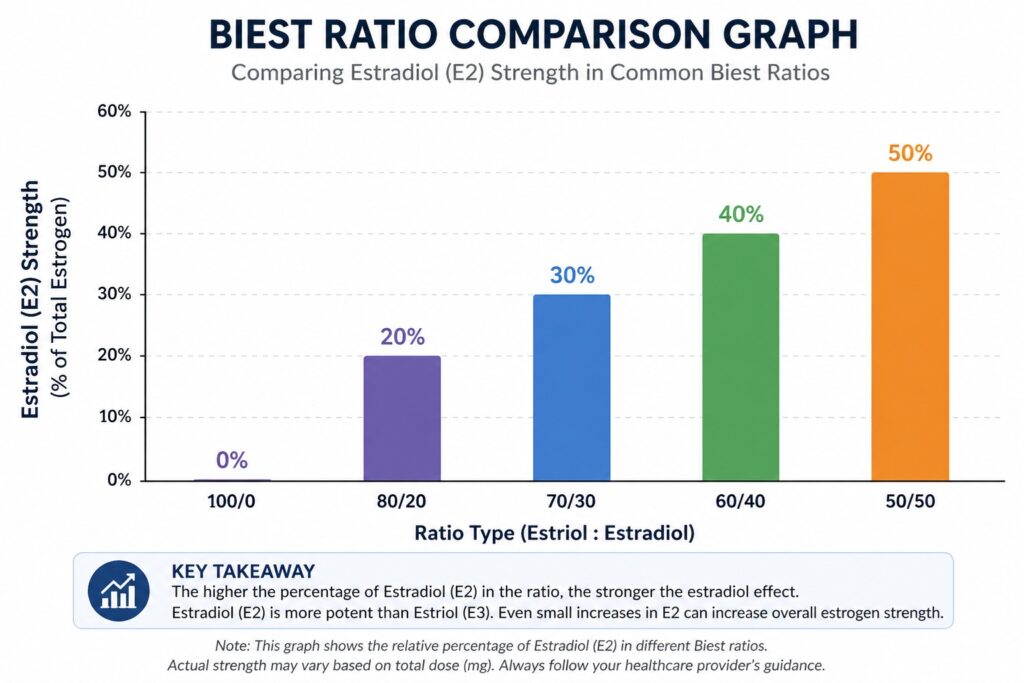
One of the most common mistakes in Biest hormone therapy calculations is mixing up the ratio and the total dose. The ratio (like 80:20 or 50:50) only shows how estriol (E3) and estradiol (E2) are divided. It does NOT tell you the actual strength. For example, a Biest 80:20 ratio could be low dose or high dose depending on total milligrams. Many beginners focus only on the ratio and ignore the full dose, which can lead to poor symptom control or side effects. Always calculate both the Biest ratio and total estrogen dose together for safe and effective results.
2. Ignoring Potency Differences
Another big mistake is not understanding that estradiol (E2) is much stronger than estriol (E3). Even a small amount of E2 can have a strong effect on the body. If you treat both hormones as equal, you may accidentally create a formula that is too strong. This can lead to symptoms like breast tenderness or mood swings. Proper hormone balance in Biest therapy requires careful attention to potency, not just numbers.
3. Incorrect Unit Conversions
Wrong unit conversion is a simple but serious error. Mixing up mg (milligrams), mcg (micrograms), or percentages can completely change the final dose. For example, 1 mg = 1000 mcg, and confusing this can cause overdosing. Always double-check your Biest calculation formula and unit conversions to ensure accuracy and patient safety.
Biest Ratio FAQs (Estriol E3 & Estradiol E2)
What is a normal Biest ratio?
A normal Biest ratio is usually 80:20 (Estriol:Estradiol) or 50:50. The 80:20 ratio is more common because it provides a gentler estrogen effect. The right ratio depends on symptoms and individual needs.
How do you calculate E3 to E2 ratio?
To calculate the E3 to E2 ratio, divide the amount of Estriol (E3) by Estradiol (E2). For example, 2 mg E3 and 0.5 mg E2 gives a 4:1 ratio. Always consider both ratio and total dose.
What does 80/20 Biest mean?
Biest 80/20 means 80% Estriol (E3) and 20% Estradiol (E2). It is a milder hormone therapy option often used for beginners or sensitive patients.
Is Estriol safer than Estradiol?
Estriol (E3) is weaker and gentler than Estradiol (E2). It has less strong effects on the body, but safety depends on the dose and patient condition.
What happens if Estradiol is too high?
High Estradiol (E2) levels can cause symptoms like breast tenderness, mood swings, headaches, and spotting. Proper hormone balance is important to avoid side effects.
Can I adjust my Biest ratio myself?
No, you should not adjust your Biest ratio on your own. Always consult a healthcare provider before making changes to hormone therapy.
What is the best Biest ratio for menopause?
The best Biest ratio depends on symptoms. Many patients start with 80:20 for gentle relief, while some may need 50:50 for stronger effects.
How is Biest compounded?
Biest is prepared in a compounding pharmacy by mixing Estriol (E3) and Estradiol (E2) in a specific ratio. It can be made as creams, capsules, or gels.
What units are used in Biest calculations?
Biest doses are measured in milligrams (mg) or micrograms (mcg). One mg equals 1000 mcg, so accurate conversion is important.
Is Biest FDA approved?
Biest is not FDA-approved as a standard product. It is a compounded medication customized for each patient, although its ingredients may be FDA-approved.
How accurate are online Biest calculators?
Online Biest calculators are useful for quick estimates, but they are not always fully accurate. Always confirm results with a pharmacist or doctor.
Medically Reviewed By
Adesh Pundir, RPh – Licensed Pharmacist since 2013
Verified for accuracy and clinical relevance.
Serving patients in Fort Worth, Texas with expertise in community pharmacy and medication safety.
Last reviewed: April 2026
Medical References & Sources
The information on this page is supported by trusted medical and scientific sources to ensure accuracy and reliability.
-
National Library of Medicine (NIH) – Estrogen Therapy Overview
https://www.ncbi.nlm.nih.gov/books/NBK541051/
Provides clinical insights into how estrogen therapy is used to treat menopausal symptoms. -
National Library of Medicine (NIH) – Estradiol (E2) Clinical Overview
https://www.ncbi.nlm.nih.gov/books/NBK549797/
Confirms estradiol as the most potent estrogen, supporting dosage and ratio considerations. -
MedlinePlus (U.S. National Library of Medicine) – Estrogen and Progestin Therapy
https://medlineplus.gov/druginfo/meds/a601041.html
Details risks, warnings, and safety considerations of hormone therapy. -
Cleveland Clinic – Types of Estrogen Explained
https://my.clevelandclinic.org/health/body/22353-estrogen
Explains differences between estriol (E3) and estradiol (E2), including potency and clinical roles.