Creatinine Clearance GFR Calculator

Creatinine Clearance (GFR) Calculator

Creatinine Clearance (GFR) Calculator

Creatinine Clearance Formula, Cockcroft-Gault equation?

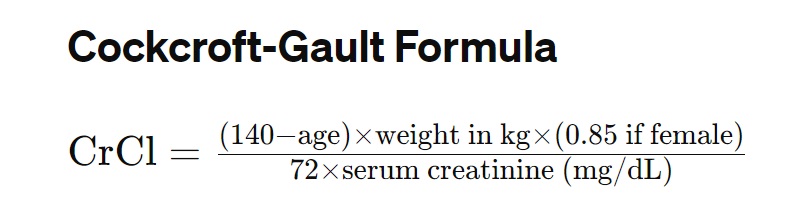
The most commonly used formula to calculate creatinine clearance is the Cockcroft-Gault equation. This equation estimates creatinine clearance based on a person’s age, weight, serum creatinine level, and gender. The formula is as follows:

creatinine clearance formula


  • Age is the person’s age in years.
  • Weight is the person’s weight in kilograms.
  • Serum Creatinine is the person’s serum creatinine level in milligrams per deciliter (mg/dL).
  • The factor 0.85 is used for females to adjust for the lower muscle mass compared to males.

This equation provides an estimation of creatinine clearance and may not be as accurate in certain populations, such as those with extreme muscle mass, amputations, or significant weight fluctuations. 

Creatinine clearance may also be affected by factors such as diet, medications, and hydration status. Our calculator provided an estimate number and may not be the most accurate one. Source

What is Creatinine Clearance?

Creatinine clearance is a measure of how effectively the kidneys filter waste products, specifically creatinine, from the blood. Creatinine is a waste product generated by the muscles from the breakdown of a compound called creatine phosphate, which is used by the muscles for energy.

The kidneys filter creatinine from the blood and excrete it into the urine. Creatinine clearance is used as an indicator of kidney function, particularly the glomerular filtration rate (GFR), which represents the rate at which the kidneys filter blood.

Creatinine Clearance Test?

The creatinine clearance test is a diagnostic test used to measure how efficiently the kidneys are filtering waste products, specifically creatinine, from the blood. Creatinine is a waste product generated by the muscles from the breakdown of a compound called creatine phosphate, which is used by the muscles for energy.

During the test, a 24-hour urine sample is collected, along with a blood sample. The urine sample measures the amount of creatinine excreted by the kidneys over a 24-hour period, while the blood sample measures the amount of creatinine present in the bloodstream.

The result of the creatinine clearance test is expressed in milliliters per minute (mL/min) and provides an estimate of the glomerular filtration rate (GFR), which represents the rate at which the kidneys filter blood.

This test is commonly used to assess kidney function, diagnose kidney diseases, monitor the progression of kidney disorders, and adjust medication dosages, particularly drugs that are eliminated by the kidneys.

Creatinine Clearance Normal Range

The normal range for creatinine clearance can vary depending on factors such as age, sex, and muscle mass. Generally, normal creatinine clearance values for adults range from approximately 90 to 140 milliliters per minute (mL/min). However, laboratories may have slightly different reference ranges.

Abnormal creatinine clearance values may indicate underlying kidney dysfunction or disease. Values below the normal range may suggest impaired kidney function, while values above the normal range may indicate hyperfiltration, which can occur in conditions such as diabetes or early kidney disease stages.

Creatinine Clearance normal range chart:

GenderNormal Creatinine Clearance Range (mL/min)Abnormal Creatinine Clearance Range (mL/min)
Male90-140Below 90 (impaired kidney function)
Female85-125*Below 85 (impaired kidney function)

*Note: The normal range for females is typically slightly lower than that for males due to differences in muscle mass.

Explanation:

Normal Creatinine Clearance Range:

    • For males, the normal range of creatinine clearance is typically between 90 to 140 mL/min.
    • For females, the normal range is slightly lower, typically between 85 to 125 mL/min, due to differences in muscle mass compared to males.

Abnormal Creatinine Clearance Range:

    • Creatinine clearance values below the normal range indicate impaired kidney function. For both males and females, values below 90 mL/min are considered abnormal.
    • It’s important to note that values may vary depending on individual factors such as age, muscle mass, and medical history.

What is normal creatinine clearance levels?

Normal creatinine clearance rates can vary by age, sex, and body size, but in general, they are used as an indicator of kidney function. Creatinine clearance is measured in milliliters per minute (mL/min) and is adjusted for body surface area. Here’s a general guideline:

  • Adult men: Typically, a normal creatinine clearance rate is about 95 to 135 mL/min per 1.73 m² of body surface area.
  • Adult women: Usually, a bit lower, around 85 to 125 mL/min per 1.73 m² of body surface area.


What creatinine level indicates kidney failure?

Creatinine levels in the blood are a key indicator of kidney function, and elevated levels can suggest kidney damage or failure. However, the exact level of creatinine that indicates kidney failure can vary based on several factors, including age, gender, muscle mass, and the lab’s specific reference ranges. Generally, creatinine levels are measured in milligrams per deciliter (mg/dL) in the United States and in micromoles per liter (μmol/L) in many other countries. Here’s a basic guideline:

  • Normal ranges: Typically, normal blood creatinine levels are approximately 0.6 to 1.2 mg/dL for men and 0.5 to 1.1 mg/dL for women. These ranges can vary slightly between labs.

  • Indication of kidney failure: A creatinine level higher than the normal range for adults may indicate kidney damage or dysfunction. In the context of kidney failure (end-stage renal disease), creatinine levels are often significantly elevated, often above 4.0 mg/dL (353.6 μmol/L), but the specific level can vary widely depending on the individual.

How to compute creatinine clearance?

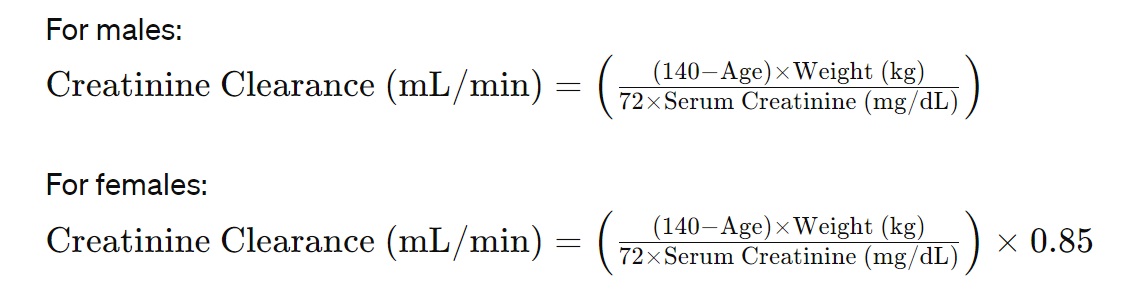
Creatinine clearance (CrCl) is calculated to estimate the glomerular filtration rate (GFR), which reflects the kidney’s function. The most commonly used method to calculate creatinine clearance is the Cockcroft-Gault formula, which considers a person’s age, body weight, sex, and serum creatinine level. It’s important to note that this formula provides an estimate of creatinine clearance adjusted for body surface area, not the actual GFR. 

Cockcroft-Gault Formula:

Cockcroft-Gault Formula

For women, the result of the calculation for men is multiplied by 0.85, reflecting the general difference in muscle mass between sexes.

  • Age is in years.
  • Weight is in kilograms.
  • Serum creatinine is in milligrams per deciliter (mg/dL).

This formula is widely used in clinical settings to adjust dosages of medications that are primarily excreted by the kidneys and to evaluate patients’ kidney function. However, it has its limitations, especially in those with very high or very low body mass, the elderly, and those with unstable kidney function.

Frequently Asked Questions (FAQs) About Creatinine Clearance and Kidney Function


Is Creatinine Clearance the Same as eGFR?

No. Creatinine clearance (CrCl) and estimated glomerular filtration rate (eGFR) are related but not identical measurements of kidney function. Creatinine clearance estimates how efficiently the kidneys remove creatinine from the blood and may require a 24-hour urine collection. eGFR is calculated using serum creatinine, age, sex, and other factors to estimate kidney filtration capacity.

Both tests help evaluate kidney health, but eGFR is generally preferred for staging chronic kidney disease (CKD).

What Creatinine Level Requires Dialysis?

Dialysis is not started based on creatinine level alone. Healthcare providers consider symptoms, laboratory values, fluid status, electrolyte abnormalities, and overall kidney function.

In many cases, dialysis is considered when the estimated glomerular filtration rate (eGFR) falls below 15 mL/min/1.73 m² or when severe symptoms of kidney failure develop.

What Creatinine Level Is Considered Dangerous?

A creatinine level significantly above the normal range may indicate impaired kidney function. For many adults, levels above 2.0 mg/dL warrant medical evaluation, although the severity depends on age, muscle mass, and underlying health conditions.

A healthcare provider should interpret creatinine values along with eGFR and other laboratory tests.

What Is a Good Creatinine Clearance Rate?

Normal creatinine clearance values generally range from:

  • Men: 95–135 mL/min
  • Women: 85–125 mL/min

Normal values may vary based on age, body size, muscle mass, and laboratory standards.

Can Creatinine Levels Return to Normal?

Yes. If elevated creatinine is caused by reversible factors such as dehydration, certain medications, or temporary illness, levels may return to normal after the underlying cause is corrected.

Chronic kidney disease, however, may cause persistent elevations in creatinine levels.

Can Creatinine Levels Fluctuate?

Yes. Creatinine levels can fluctuate due to hydration status, dietary protein intake, exercise, muscle mass changes, illness, and medication use.

Small day-to-day variations are common and may not necessarily indicate worsening kidney function.

Can Creatinine Levels Be Lowered?

Creatinine levels can often improve when the underlying cause of kidney dysfunction is treated. Managing blood pressure, controlling diabetes, staying hydrated, and avoiding kidney-toxic medications may help improve kidney function.

Lifestyle modifications and physician-directed treatment plans are important for protecting kidney health.

At What Creatinine Level Should Metformin Be Stopped?

Modern guidelines primarily use eGFR rather than serum creatinine alone when evaluating metformin use.

Metformin is generally contraindicated when eGFR falls below 30 mL/min/1.73 m². Dose adjustments and closer monitoring may be recommended when eGFR is between 30 and 45 mL/min/1.73 m².

Patients should always follow their healthcare provider's recommendations regarding medication changes.

What Creatinine Level Indicates Stage 3 Kidney Disease?

Stage 3 chronic kidney disease (CKD) is not defined by a specific creatinine level. Instead, it is classified by an eGFR between 30 and 59 mL/min/1.73 m².

Because creatinine levels vary between individuals, eGFR is considered a more accurate measure for CKD staging.

Are Creatinine Clearance and GFR the Same?

No. While both measure kidney function, they are calculated differently. Glomerular filtration rate (GFR) estimates overall kidney filtering capacity, whereas creatinine clearance specifically measures the rate at which creatinine is removed from the blood.

Both values are useful in assessing kidney health and medication dosing adjustments.

Why Do Creatinine Levels Increase?

Creatinine levels may increase due to kidney disease, dehydration, uncontrolled diabetes, high blood pressure, urinary tract obstruction, or medications that affect kidney function.

Increased muscle mass, intense exercise, and high-protein diets can also contribute to elevated creatinine levels.

Scroll to Top