
Alligation Calculator for Pharmacy Students, Technicians and Pharmacists
Alligation Calculator for Compounding
Reviewed for medical accuracy | Updated April 2026
What is alligation method?
The alligation method is a quick math trick used in compounding pharmacies to figure out how to mix two ingredients to get a specific strength. It is a big time-saver when you need to calculate proportions, especially for creams or solutions.
So, you have two strengths of the same cream, right? One is super strong and one is weak. But you need a medium-strength cream. The alligation method is just a super easy trick to figure out how much of each to mix together.
Imagine a simple tic-tac-toe grid. You put the strong number in the top left, the weak number on the bottom left. Your target strength goes in the middle. Then you just subtract on the diagonal. The answers you get are the exact number of “parts” of each cream you need to mix. It makes compounding math way less of a headache.
What Is Alligation in Pharmacy?
Alligation is a simple pharmacy calculation method used to determine the correct ratio of two ingredients with different strengths to make a desired strength. It helps pharmacy professionals mix solutions, creams, or medications accurately and efficiently.
Understanding alligation in a pharmacy setting is important because it ensures patients receive the correct concentration of a medication. Pharmacy technicians commonly use alligation when preparing compounded products or dilutions. This calculation method is also an important topic on the NAPLEX exam and PTCB exam, making it essential for pharmacy students to learn and practice as part of their pharmacy math skills.
Alligation Formula
Use the alligation formula to determine the ratio of two different strengths needed to obtain a desired strength.
Parts of Higher Strength = Desired Strength − Lower Strength
Parts of Lower Strength = Higher Strength − Desired Strength
Quick Tip: The resulting numbers represent the ratio of each strength needed to prepare the desired concentration.
Alligations Calculation Example 1
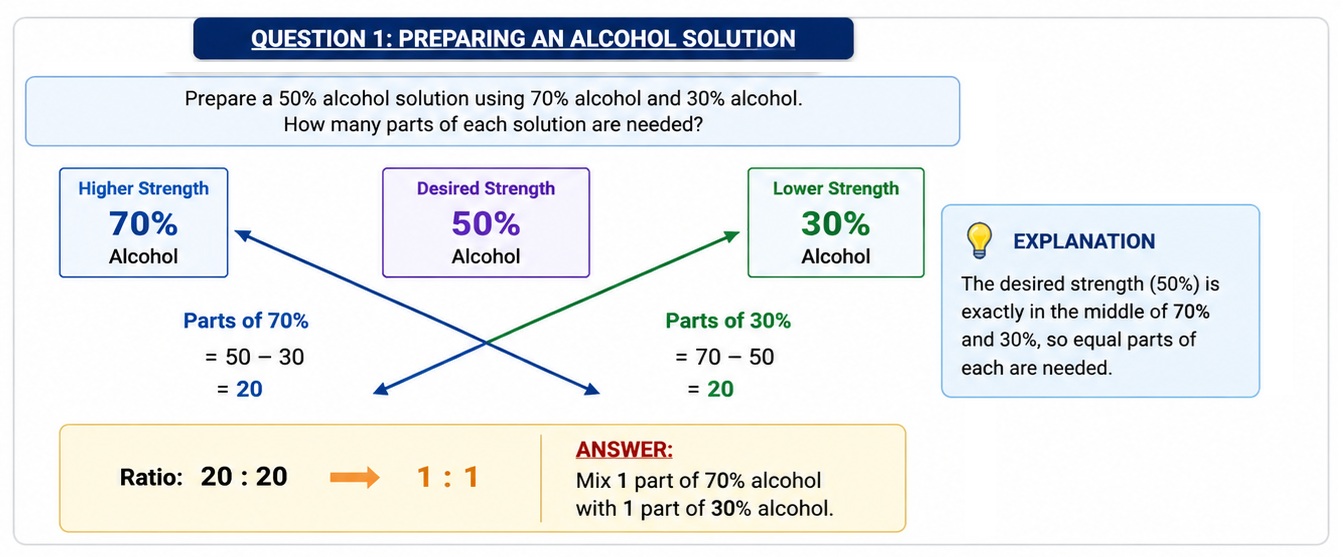
Preparing an Alcohol Solution: A pharmacy technician needs to prepare a 50% alcohol solution using 70% alcohol and 30% alcohol. How many parts of each solution are needed?
Step 1: Set up the alligation
- Higher Strength = 70%
- Desired Strength = 50%
- Lower Strength = 30%
Step 2: Calculate the parts
- Parts of 70% alcohol = 50 − 30 = 20
- Parts of 30% alcohol = 70 − 50 = 20
Step 3: Determine the ratio
Ratio = 20 : 20 = 1 : 1
Answer
Mix 1 part of 70% alcohol with 1 part of 30% alcohol.
Explanation
When the desired strength is exactly halfway between the two available strengths, equal amounts of each solution are required. This is a common alligation calculation used in pharmacy compounding and dilution preparation.
Alligation Calculation Example 2
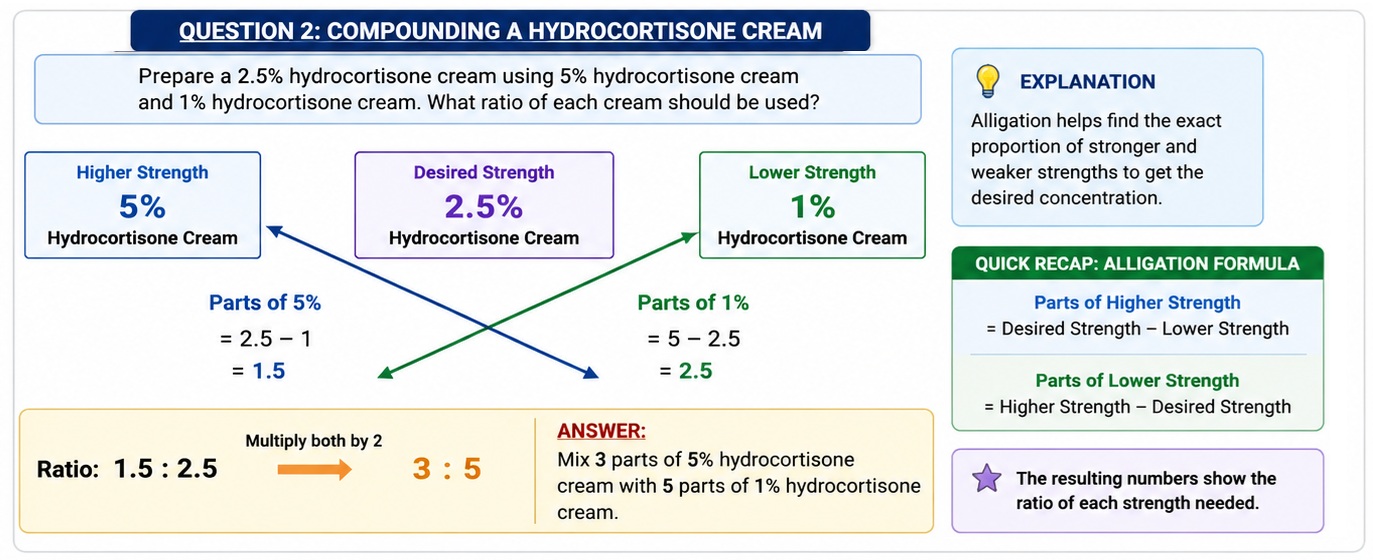
Compounding a Hydrocortisone Cream: A pharmacist asks a technician to prepare a 2.5% hydrocortisone cream using 5% hydrocortisone cream and 1% hydrocortisone cream. What ratio of each cream should be used?
Step 1: Set up the alligation
- Higher Strength = 5%
- Desired Strength = 2.5%
- Lower Strength = 1%
Step 2: Calculate the parts
- Parts of 5% cream = 2.5 − 1 = 1.5
- Parts of 1% cream = 5 − 2.5 = 2.5
Step 3: Express the ratio
- Ratio = 1.5 : 2.5
- Multiply both sides by 2:
- Ratio = 3 : 5
Answer
Mix 3 parts of 5% hydrocortisone cream with 5 parts of 1% hydrocortisone cream.
Explanation
Alligation helps determine the exact proportion of stronger and weaker products needed to achieve the desired concentration. In this case, combining the creams in a 3:5 ratio produces a final hydrocortisone concentration of 2.5%.
Alligation vs Dilution
Alligation and dilution are both pharmacy calculation methods used to prepare medications with specific concentrations, but they work differently.
- Alligation is used when two solutions with different strengths are mixed together to obtain a desired strength.
- Dilution is used when a stronger solution is mixed with a diluent, such as water or saline, to reduce its concentration.
Pharmacy technicians use both methods in compounding and medication preparation. Understanding the difference between alligation and dilution is important for pharmacy practice and is a common topic on the PTCB exam and other pharmacy technician training programs.
✅ Alligation = Mix Two Strengths
✅ Dilution = Add Diluent to Reduce Strength
Comparison Table: Alligation vs Dilution
| Feature | Alligation | Dilution |
| Purpose | Mix two different strengths to obtain a desired strength |
Reduce the concentration of a stronger solution
|
| Number of Solutions | Two solutions of different strengths |
One concentrated solution and one diluent
|
| Common Formula | Alligation Method (Cross Difference) | C₁V₁ = C₂V₂ |
| Used When | Desired strength lies between two available strengths |
A stronger solution must be weakened
|
| Example | Mix 70% alcohol and 30% alcohol to make 50% alcohol |
Dilute 10 mL of 20% solution to make a 10% solution
|
| Requires Diluent? | Not necessarily | Yes |
| Pharmacy Applications | Compounding creams, ointments, and solutions |
IV preparations, oral liquids, and reconstitutions
|
| PTCB Relevance | Frequently tested |
Frequently tested
|
| Main Goal | Determine mixing ratio |
Determine final volume or amount of diluent
|
| Calculation Focus | Ratio of ingredients |
Concentration and volume relationship
|
Frequently Asked Questions About Alligation in Pharmacy
1. What is alligation in pharmacy?
Alligation is a pharmacy calculation method used to determine the ratio of two ingredients with different strengths needed to achieve a desired concentration. It is commonly used in compounding medications, solutions, creams, and ointments.
2. When should alligation be used?
Alligation should be used when you need to mix two products of different strengths to obtain a specific desired strength. It is useful when the desired concentration falls between the strengths of the available products.
3. Can alligation be used for IV solutions?
Yes, alligation can be used for IV solutions when two solutions of different concentrations are mixed to achieve a target concentration. However, pharmacists must also consider compatibility, sterility, and volume requirements.
4. Is alligation on the PTCB exam?
Yes. Alligation is a common pharmacy math topic tested on the PTCB exam. Pharmacy technicians should understand how to calculate ratios and concentrations using the alligation method.
5. Is alligation on the NAPLEX exam?
Yes. Pharmacy students preparing for the NAPLEX should be familiar with alligation calculations because they are frequently used in compounding and dosage preparation scenarios.
6. What is the difference between alligation and dilution?
Alligation mixes two different strengths to obtain a desired concentration, while dilution reduces the concentration of a stronger solution by adding a diluent such as water or saline. Alligation uses ratios, whereas dilution commonly uses the C₁V₁ = C₂V₂ formula.
7. Can alligation be used for cream compounding?
Yes. Pharmacists and pharmacy technicians frequently use alligation when compounding creams, ointments, and topical preparations to achieve a specific drug concentration.
8. What are the limitations of alligation?
Alligation works only when the desired strength falls between the strengths of the two available products. It does not account for chemical compatibility, stability, or physical properties of the ingredients being mixed.
9. How do you calculate ratios using alligation?
To calculate ratios, subtract the lower strength from the desired strength and subtract the desired strength from the higher strength. The resulting values represent the ratio of the higher-strength and lower-strength ingredients needed.
10. Why is alligation important for pharmacists?
Alligation helps pharmacists accurately prepare medications with the correct concentration. Proper calculations improve patient safety, ensure dosing accuracy, and support effective compounding practices.
References
- Fundamentals of Pharmacy Calculations. OER Commons. Available at: https://oercommons.org/courseware/lesson/115797/student/?section=21
- Borrowing a Useful Concept from the Pharmacy Curriculum. Journal of Chemical Education, American Chemical Society. Available at: https://pubs.acs.org/doi/10.1021/acs.jchemed.4c00559
- Alligation Alternate and the Composition of Medicines: Arithmetic and Medicine in Early Modern England. National Center for Biotechnology Information (NCBI). Available at: https://www.ncbi.nlm.nih.gov/pmc/articles/PMC1172291/
- Alligation Medial and Alternate. RxPharmaLab Educational Resources. Available at: https://www.rxpharmalab.com/RXpharmaLAB/capsules/AlligationEN.pdf